
PiecesPast
[ News | Go - Kingston | Discover Jamaica ]


For Your Listening Pleasure
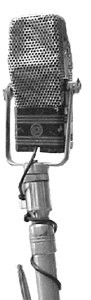
(Some fifty years after its inception radio is still the most powerful, far-reaching form of media in Jamaica. More than 2 million of the island's 2.5 million people are said to be radio listeners.)

Almost everywhere one goes in Jamaica one hears the sounds of music and voices of people expressing their opinions on numerous talk shows. Offices, street corners, restaurants and bars ­ anywhere you find a group of Jamaicans gathered, you will more than likely find a radio playing.

Radio's relationship with the national psyche began as early as 1939 when the first broadcast was transmitted via a shortwave "ham" operated unit from the Seaview Ave. home of the unit's owner, John Grinan. The call sign was VP5PZ and it offered wartime news and information for a half-hour once a week.

By 1940, Grinan had negotiated with the colonial government to set up a station that became known as ZQI and the frequency and variety of broadcasts increased. But listenership never totalled more than 100,000 given the relatively high cost of radio sets.

Then on July 9,1950, (fifty-one years ago) commercial radio broadcasting began when the government, like those in many other Caribbean territories during that decade, granted a license to the Jamaica Broadcasting Company a subsidiary of the British Rediffusion Group. This signalled the birth of the Radio Jamaica and Rediffusion Network or, as we know it today, RJR. Four transmission sites were established across the island to carry the medium wave signals. This early RJR was quite British in character, producing a very BBC-like format. Slowly but surely, however, more and more Jamaicans moved in and some of the flavour of Jamaica began to be heard.

Popular shows included Talent Parade, opened by Karl Magnus' regular "Well, look, here's something that just came to me!" line, and originally produced by Archie Lindo and Hugh Wilson. Talent Parade showcased local talent broadcast from the Carib Theatre and helped to launch the careers of well-loved entertainers including Ranny Williams and Louise Bennett. Other popular shows included Alma Mock-Yen's Tea Time and Marie Garth's Busy Bee Club for children. Favourite announcers and programme hosts emerged including: Merrick Needham, possibly best known for his ceremonial outside broadcasts, Dorothy Hosang (Lannaman's Lollipop Land for children) Adrian Robinson, Tony Verrity, Roy Reid (Reid at Random), Radcliffe Butler (The Butler Did It, Midnight Mood), and Dorothy La Croix, better known as Dottie Dean.

In an effort to broaden listenership in the early 1950s RJR distributed some 200 "little brown radio boxes" (rediffusion boxes) to communal locations like police stations, schools and shops so that more Jamaicans would have access to radio information and programming. By 1954 over 57,000 Rediffusion sets were in use and over 285,000 Jamaicans were confirmed radio listeners (a major increase from the 75,000 in 1947). Radio programmes also began to be sponsored by companies that increasingly used the radio as a medium of advertisement - these proceeds were the station's only sources of income. These commercials were either pre-recorded or voiced live from the studio.

Between 1950 and the mid-1960s RJR became a household word and improvements in radio transmission occurred. 1951 ushered in wire radio service - meaning that transmissions were sent from a central station, better able to withstand atmospheric conditions and reach a wider listenership. But to receive them you had to be a rediffusion subscriber, paying three-pence a day. As Merrick Needham describes, this early form of radio transmission was "a bit like cable TV but with sound."

All photos courtesy of RJR Communications Group.


Give Us Your Feedback | Read what others had to say
Name
E-mail
Country
Comments
Complete List of Past Pieces
• Current
• Port Royal Earthquake
• Port Royal Earthquake : I Was There
• June 20, 1965: Martin Luther King Jr. visits Jamaica
• Bog Walk Tube
• For Your Listening Pleasure
• The Road to Freedom
• Birth of Independence
• Hurricane of 1780
• Tragedy at Kendal 1957
• The Ward Theatre 1912
• The Guarded City: Port Royal 1690
• The Triumph of Will:1960s
• The History of Our Parishes
• Jamaica and the Great War
• Jamaica's Grand Hotels
• Celebrating Christmas Jamaica 'Style'
• Disaster - The Earthquake of 1907
• The Great Exhibition of 1891
• The Mutiny On The Bounty & The Arrival of The First Breadfruit 1793
• The Fall Of A Gentle Giant: The Collapse of Tom Cringle's Cotton Tree
• Jamaica's Botanical Gardens
• All Hail The State Visit Of Emperor Haile Selassie I
• Jamaican Healer And War Heroine Mary Seacole
• Mistresses Of The Sea: Female Pirates Mary Read and Anne Bonny
• The Capital City: A Historic Look At Kingston
• Riots Here: Send Help At Once
• A Historic Portrait of the Town Where Jamaica's Tourism Began
• Devon House -The first 500 years in Jamaica
• Jamaican Coffee - A beverage of distinction
• Jamaican Rum - A kill-devil of a drink
• Jamaica Festival - What a Bam Bam
• Captivated by Jamaica - Sir Hans Sloane's Passion for Jamaica
• Captivated by Jamaica Pt II - Noel Coward, Errol Flynn and Ian Fleming
• The Founding Of The BITU & The JLP
• The Founding Of the People's National Party
• Lewis Hutchinson: The Mad Master
• A Pioneer, A Survivor: Dr. Cicely Williams
•

Henry Morgan: The Pirate King

• Claude McKay: Jamaica's First Poet Laureate
• Frazier versus Foreman on the Sunshine Island 1973
• The Magical Spiderman: Anancy
• The Case Of The Shark Papers
• Katherine Dunham - Matriarch of Modern Dance
• Money - The Roots of Jamaican Currency
• Simon Bolivar: El Liberatador
• Old Time Tellin's: A Closer Look At Jamaican Proverbs
• Recollections of World War II
• Place Names - A Window to Jamaica's History & Character: Wnat's In A Name?
• The History Of Spanish Town
• A Cultural Explication Of Empire: Lady Nugent's Journal
• The History Of Falmouth: Boom Town Of The 19th Century
• Dreamers Among Us - Famous Jamaican Scientists- Prof. Louis Grant 1913 - 1993 Part I
• Dreamers Among Us - Famous Jamaican Scientists-Part II
• Out Of Many Cultures: The People Who Came - The Jews In Jamaica
• Out Of Many Cultures: The People Who Came - The Chinese
• Out Of Many Cultures: The People Who Came - The Lebanese
• Out Of Many Cultures: The People Who Came - The Indians
• Out Of Many Cultures: The People Who Came - The Irish
• Out Of Many Cultures: The People Who Came - The Africans
• Out Of Many Cultures: The People Who Came - The Germans
• Colourful Characters - Jamaican Birds
• The Stamp Of History: The Jamaican Postal Service
• The People Who Came - The English
• Old-time Jamaican weddings
• In this place dwelt Horatio Nelson
• Printing in Jamaica
• Museums in Jamaica
• Gibraltar Camp: A Refuge From War
• HISTORY OF AVIATION IN JAMAICA: PART I
• HISTORY OF AVIATION IN JAMAICA: PART II
• Roads & RESISTANCE
• KINGSTON'S HISTORIC AND DIVERSE PLACES OF WORSHIP RELIGIOUS ICONS part 1
• KINGSTON'S HISTORIC AND DIVERSE PLACES OF WORSHIP RELIGIOUS ICONS part 2
• The history of the Salvation Army in Jamaica CHRISTIAN SOLDIERS
• Somewhere beyond the sea
• A fascination with football
• Jamaican Horse racing History
• A Time to Live...Jamaican Birth Rituals
• A Time to Die Death rituals
• Deadly superstitions

Radio Trivia

Did you know that FAME FM (which began in 1984) stands for Fraternity of Amazing Musical Expression...?

How about KLAS (which began in the later 1980s)? It stands for Keeping Listeners Aware in Style.

Dates when stations began broadcasting:
RJR radio 1 1950
JBC radio 1959
RJR radio 2 1972
FAME FM 1984
KLAS 1989
Hot 102 1989
Irie 1990
Power 106 1992
LOVE FM 1993

Radio TimeLine

1939: First broadcast transmitted via shortwave 'ham' radio.

1950: Gov't granted licence to the Jamaica Broadcasting Company for commercial radio broadcasting.

1951: RJR moved to a new studio on Lyndhurst Rd.

1953: FM Band transmission was introduced ­ Jamaica was the first British colony to boast of such a service.

1956: RJR began a schools broadcasting service and placed radios in schools across the island.

1959: Government started its own station, JBC radio through The Jamaica Broadcasting Corporation. The name of the company under which RJR operated was formally changed to that of Radio Jamaica Limited, the name by which it is known today.

1959: Government started its own station, JBC radio through The Jamaica Broadcasting Corporation. The name of the company under which RJR operated was formally changed to that of Radio Jamaica Limited, the name by which it is known today.

1962: RJR began a service known as 'Reditune' which allowed for non-stop music. This was replaced later in the 1960s by 'Musipage' which allowed for live broadcasts of musical performances from radio stations.

RJR began a service known as 'Reditune' which allowed for non-stop music. This was replaced later in the 1960s by 'Musipage' which allowed for live broadcasts of musical performances from radio stations.


Feedback To the Series

"Dr. King's valedictory speech is a motivation to myself and family. We'll try to live by this. "

"Pieces of the Past" what a good idea, what a pleasure to read and
see! My Jamaican husband and me, a German Jamaica lover,
appreciate the chance to learn more about Jamaican history.
Dankeschön!"


The First 500 years in Jamaica

We're taking you for a stroll down memory lane for the next six months. Along this journey,we will relive several events which
significantly impacted on the social, political and economic development of Jamaica. As we travel share your experience with us...

Send your comments to:

Pieces of the Past,
The Gleaner Company Ltd.,
7 North Street, Kingston;

E - mail us:
editor@gleanerjm.com

Fax 922-6223.


A Jamaica Gleaner Feature
Copyright 2001. Produced by Go-Jamaica.com