
PiecesPast
[ News | Go - Kingston | Discover Jamaica ]


Honesty Is The Best Policy -
The Case Of The Shark Papers

Complete List of Past Pieces
• Current
• Port Royal Earthquake
• Port Royal Earthquake : I Was There
• June 20, 1965: Martin Luther King Jr. visits Jamaica
• Bog Walk Tube
• For Your Listening Pleasure
• The Road to Freedom
• Birth of Independence
• Hurricane of 1780
• Tragedy at Kendal 1957
• The Ward Theatre 1912
• The Guarded City: Port Royal 1690
• The Triumph of Will:1960s
• The History of Our Parishes
• Jamaica and the Great War
• Jamaica's Grand Hotels
• Celebrating Christmas Jamaica 'Style'
• Disaster - The Earthquake of 1907
• The Great Exhibition of 1891
• The Mutiny On The Bounty & The Arrival of The First Breadfruit 1793
• The Fall Of A Gentle Giant: The Collapse of Tom Cringle's Cotton Tree
• Jamaica's Botanical Gardens
• All Hail The State Visit Of Emperor Haile Selassie I
• Jamaican Healer And War Heroine Mary Seacole
• Mistresses Of The Sea: Female Pirates Mary Read and Anne Bonny
• The Capital City: A Historic Look At Kingston
• Riots Here: Send Help At Once
• A Historic Portrait of the Town Where Jamaica's Tourism Began
• Devon House -The first 500 years in Jamaica
• Jamaican Coffee - A beverage of distinction
• Jamaican Rum - A kill-devil of a drink
• Jamaica Festival - What a Bam Bam
• Captivated by Jamaica - Sir Hans Sloane's Passion for Jamaica
• Captivated by Jamaica Pt II - Noel Coward, Errol Flynn and Ian Fleming
• The Founding Of The BITU & The JLP
• The Founding Of the People's National Party
• Lewis Hutchinson: The Mad Master
• A Pioneer, A Survivor: Dr. Cicely Williams
•

Henry Morgan: The Pirate King

• Claude McKay: Jamaica's First Poet Laureate
• Frazier versus Foreman on the Sunshine Island 1973
• The Magical Spiderman: Anancy
• The Case Of The Shark Papers
• Katherine Dunham - Matriarch of Modern Dance
• Money - The Roots of Jamaican Currency
• Simon Bolivar: El Liberatador
• Old Time Tellin's: A Closer Look At Jamaican Proverbs
• Recollections of World War II
• Place Names - A Window to Jamaica's History & Character: Wnat's In A Name?
• The History Of Spanish Town
• A Cultural Explication Of Empire: Lady Nugent's Journal
• The History Of Falmouth: Boom Town Of The 19th Century
• Dreamers Among Us - Famous Jamaican Scientists- Prof. Louis Grant 1913 - 1993 Part I
• Dreamers Among Us - Famous Jamaican Scientists-Part II
• Out Of Many Cultures: The People Who Came - The Jews In Jamaica
• Out Of Many Cultures: The People Who Came - The Chinese
• Out Of Many Cultures: The People Who Came - The Lebanese
• Out Of Many Cultures: The People Who Came - The Indians
• Out Of Many Cultures: The People Who Came - The Irish
• Out Of Many Cultures: The People Who Came - The Africans
• Out Of Many Cultures: The People Who Came - The Germans
• Colourful Characters - Jamaican Birds
• The Stamp Of History: The Jamaican Postal Service
• The People Who Came - The English
• Old-time Jamaican weddings
• In this place dwelt Horatio Nelson
• Printing in Jamaica
• Museums in Jamaica
• Gibraltar Camp: A Refuge From War
• HISTORY OF AVIATION IN JAMAICA: PART I
• HISTORY OF AVIATION IN JAMAICA: PART II
• Roads & RESISTANCE
• KINGSTON'S HISTORIC AND DIVERSE PLACES OF WORSHIP RELIGIOUS ICONS part 1
• KINGSTON'S HISTORIC AND DIVERSE PLACES OF WORSHIP RELIGIOUS ICONS part 2
• The history of the Salvation Army in Jamaica CHRISTIAN SOLDIERS
• Somewhere beyond the sea
• A fascination with football
• Jamaican Horse racing History
• A Time to Live...Jamaican Birth Rituals
• A Time to Die Death rituals
• Deadly superstitions


Feedback To the Series

"I have found your articles on the Pieces of the Past most entertaining and interesting to read. For me as a historian these pieces come at a time when Jamaicans need to reconnect themselves with their past and the Gleaner's efforts through this medium is quite commendable.

I have found especially today's article on the 1780 hurricane to be quite of interest to me as I am currently involved in bringing to light the role of natural disasters in the development of Jamaica's history, culture, society, economy and politics and the article on the "Hurricane of 1780" has greatly aided in this direction. Keep up the good work and I look forward to more interesting and historically significant pieces from this series." - Kerry-Ann


The First 500 years in Jamaica

We're taking you for a stroll down memory lane for the next six months. Along this journey,we will relive several events which
significantly impacted on the social, political and economic development of Jamaica. As we travel share your experience with us...

Send your comments to:

Pieces of the Past,
The Gleaner Company Ltd.,
7 North Street, Kingston;

E - mail us:
editor@gleanerjm.com

Fax 922-6223.

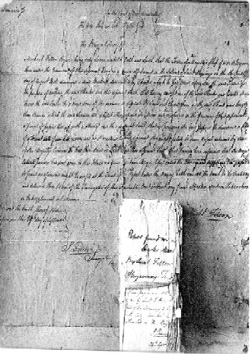
The 'Shark Papers' (above) are at the Jamaica Institute, in Kingston, and the head of the shark that swallowed the papers is in the British Museum in England.

By Dr. Rebecca Tortello

OVER 200 years ago the Jamaica Court of Vice-Admiralty heard what is surely one of the strangest cases ever to come before a judge. In a classic example of the old adage truth is stranger than fiction, on September 9, 1799 a suit for salvage involving a shark, papers and a prize captured in the Caribbean sea by a British warship was brought before the court at the south west corner of Harbour and Hanover streets. Filed by the Advocate-General George Crawford Ricketts, on behalf of Hugh Whylie, Commander of the "Sparrow," and his crew, against a vessel called the "Nancy" and her crew.

The story sounds simple and straightforward but as with many such stories, it was anything but. At the time Britain was at war with France, the Netherlands and Spain and the Caribbean was teeming with conflict. This story began in July of 1799 when the "Nancy" set sail from Baltimore, Maryland, for the Dutch West Indian island of Curacao. Part of a firm that traded regularly between Baltimore, Curacao and Haiti, it was not the first time the "Nancy" had made this trip. She carried her usual cargo of German goods and was scheduled to stop in at Haiti on the homeward leg to pick up coffee.

  THE VOYAGE
Captained by Thomas Briggs, an American, the voyage went well until changes in wind and current caused him to put in at Aruba, 50 miles from Curacao. Many ships often used bad weather as an excuse to veer off course and in neutral ports such as Aruba, ships could clear cargo intended for prohibited ports and find anything from arms to false papers.

Briggs went on to Curacao and met up with his vessel accompanied by an agent of the firm who is said to have inspected the "Nancy" and found everything in order. En route for Port-au-Prince, Briggs was again the victim of bad weather and was forced to put in at Ile-a-Vache, a small island south of Haiti, to refit his damaged main topmast. The "Nancy" was never to reach Haiti, as soon after, she was sighted by Commander Whylie of the British cutter the "Sparrow," who, suspicious that the ship was carrying contraband, immediately called a warning and gave chase. Knowing the "Nancy" was no match for the speed of the "Sparrow," Briggs went below deck and surfaced with a sense of the inevitable. His ship was sealed, his papers collected and all were remanded to Port Royal. It was August 28.

In September, the British Commander, Whylie, brought suit against Briggs and Briggs replied in kind, filing a claim for dismissal with costs. Briggs seemed to have the upper hand and was clearly on the way to being acquitted as no evidence existed to convict him for smuggling, when suddenly, just before the final decision was taken, a ship known as the "Ferret" arrived in Kingston with important information pertaining to the case.

THE SHARK
Fitton and British Commander Whylie had met on the high seas, near Tacmel, Haiti, that same August while both were seeking to earn their share of prizes using warships to capture goods from enemy vessels. On August 30, (2 days after Whylie had captured Briggs and the "Nancy"), while waiting for Whylie to join him aboard his brig the "Ferret" for breakfast, a strange object still being eaten by sharks was seen floating by. It turned out to be a dead bullock and Fitton, hoping to catch an unusually large shark seen swimming near it, ordered the bullock to be taken in tow alongside his ship. Fitton managed to outwit the shark and it was soon hoisted on deck. While cleaning the giant fish, the crew came across a bundle of papers tied with string. Fitton glanced through them a bit astonished. His astonishment grew as he recognized a paper with a recent date from Curacao. The papers were from a ship called the "Nancy"­ to Fitton that meant it was perhaps a recent prize captured in the same Caribbean waters.

Fitton ordered the papers separated and left to dry while he returned to his breakfast with Commander Whylie, looking forward to sharing his good fishing fortune. During their conversation he learned of Whylie's good fortune in capturing the "Nancy" a few days earlier. Stunned, Fitton exclaimed, "But I think I have her papers!" Whylie, in shock himself, retorted, "That's impossible, I have them. I sealed the ship myself." Fitton simply stood up and gestured for Whylie to follow him to the shark.

Fitton was correct and the papers Briggs had given Whylie were false. These "shark" papers, again tied with string and taken to Kingston were lodged by Fitton with the Surrogates of the Court, contained information that proved to be the deciding factor in the case. The "Nancy" and her cargo were deemed a fair and lawful prize on the high seas. Interestingly, soon before the real papers appeared, Briggs, captain of the "Nancy" is on record committing perjury, stating that no papers of any kind were burnt or thrown overboard, destroyed, cancelled or concealed and furthermore that no such attempts were made. Briggs, more shocked than anyone at the strange turn of events, it is said, took a long time to recover from what he described as this most "active and unnatural piece of cruelty" in which he was "damned and condemned" by what he termed a "bloody sharkfish!"

The "Shark Papers" as they came to be known, were kept by the Vice-Admiralty Court's Archives until 1890 when they were put on display at the Institute of Jamaica. For a while the shark's jaws were on display near the courthouse at the corner of Harbour and Hanover streets as a reminder that honesty is the best policy. They were later sent to the Royal United Service Museum in London but are now at the Institute
of Jamaica.

NOTES
During the earthquake of 1907, the shark papers disappeared for a short time. They were found in the hands of a looter who could not account for how they came into his possession and who soon returned them to the Institute of Jamaica.

SOURCES
Black, C. V. (1966). Tales of Old Jamaica. Longman Caribbean.

Coming February 24:
This series explores dancer and anthropologist, Katherine Dunham.


Give Us Your Feedback | Read what others had to say
Name
E-mail
Country
Comments

A Jamaica Gleaner Feature originally posted February 10, 2003
Copyright 2001-3 . Produced by Go-Jamaica.com