|
Our
Parishes
 |
|
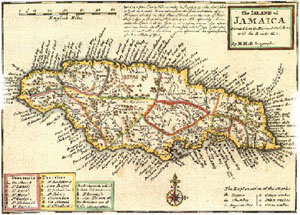
Jamaica's
parishes in 1728
|
How
did they come about and how did they get their names - Jamaica's parishes
explained.
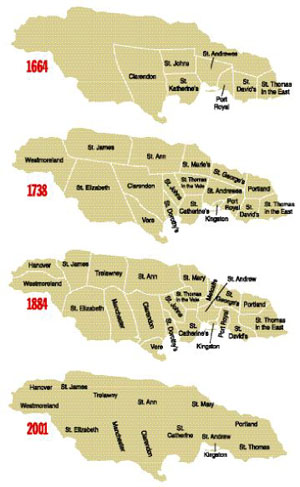
IN 1664, the Spanish relinquished control of Jamaica to the British and
Sir Thomas Modyford divided this fair isle into 7 administrative units
known as parishes. These were located mainly in the mid to south- eastern
end of the island: Clarendon, St. John's, St. Andrew's, St. Katherine's,
Port Royal, St. David's and St. Thomas in the East. Within 25 years, by
1683 the number of parishes had doubled totalling 15 parishes as St. Dorothys,
St. Thomas in the Vale, Vere, St. George's, St. Marie's and St. Ann's
and St. James and St. Elizabeth's were added. In
1692 earthquake
survivors fled across the harbour and Kingston was formed a year later.
 |
|
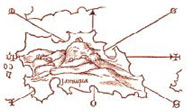
1528:
Earliest map featuring Jamaica.
Courtesy of Aaron and Marjorie Matalon's gift collection to the
National Gallery of Jamaica
|
By the
mid-eighteenth century parishes covered the entire island. In 1758 the
island's 3 counties Surrey, Middlesex and Cornwall were created to
facilitate more convenient holdings of courts of Justice. Surrey has 4
parishes Kingston, the smallest parish, St. Andrew, St. Thomas and Portland.
Middlesex has 5 St. Catherine, St. Mary, Clarendon, St. Ann and Manchester.
Cornwall also has 5 St. Elizabeth, Trelawny, St. James, Hanover, the
second smallest parish in the island, and Westmoreland. In the mid-nineteenth
century, Jamaica recorded its largest number of parishes 22. In 1867
some parishes were melded into others and the island was left with 14
the number of parishes we have today. Each parish has a capital town
and serves as a unit of local government. Kingston, which existed as a
settlement of houses in the mid-1600s prior to even its formation as a
town, became the capital of Jamaica in 1872. It acquired this position
due to its function as a major centre for commerce and communication.
THE PARISHES OF SURREY
The parish of St. Andrew, formed in 1867, was originally called Liguanea
after the Liguanea Plain in which it lies. Since most of the other 13
parishes were named after governors of Jamaica, their wives, or English
kings, it is possible that St. Andrew derived its name similarly. St.
Thomas, for example, may have been named after Thomas, Lord Windsor, Governor
of Jamaica in 1662. Portland was named after the Duke of Portland, Governor
in 1723, the year of the parish's formation. Kingston was once called
Beeston after Sir William Beeston who served as Lt.-Governor of the island
from 1693-1700. It is not known how the parish received the name Kingston
although a letter from Port Royal dated July 3, 1693 referred to it being
known by some as "Kingston" and others as "killcown". Kingston was made
a parish in 1713.
THE PARISHES OF MIDDLESEX
St. Catherine, formed in 1867, was named after Charles II's Queen, Katherine,
and it was once spelled as such. Charles II was king when the parish was
formed. St. Mary, may have been named after the Spanish port Santa Maria,
although Modyford's daughter was called Mary and when St. Mary was first
formed, it was next to the parish of St. George which was named after
George Nedham, Mary's husband. Clarendon was named after Cromwell, the
Lord Chancellor and St. Ann was named after Ann Hyde, wife of James II.
In 1814 Manchester was formed from the parishes of Clarendon, Vere and
St. Elizabeth. It was named after the Duke of Manchester who was governor
of Jamaica when it was formed.
THE PARISHES OF CORNWALL
St. Elizabeth was named in honour of Elizabeth, wife of Sir Thomas Modyford,
who was Governor when it was formed in the seventeenth century. Trelawny,
formed in 1770 was named for former governor Sir William Trelawny who
died in Jamaica in 1772. St. James was named for the Duke of York who
became James II. Hanover, formed in 1725-26 out of parts of Westmoreland
and St. James, it was named after the then reigning family in England
it was originally to be called St. Sophia in honour of the mother of
George I but this idea was overridden. Formed in 1703, Westmoreland's
name may simply come from the fact that it is the westernmost parish in
the island. Each parish has unique places of interest and characteristics.
St. Ann, for example, is known as the Garden Parish for its extreme beauty.
The population of our 14 parishes is approximately 2.6 million people,
the majority of which reside in the parishes of Kingston and St. Andrew.
Article by Rebecca Tortello.
Sources: Bryce, W. (1946) Ed. Reference Book of Jamaica, B.W.I., Cundall,
F. (1926) Handbook of Jamaica for 1926, The Gleaner (1995). Geography
and History of Jamaica. 24th Edition, Our Island, Jamaica, Mike Morrissey.
A
QUICK LOOK AT PARISH CHANGES OVER THE CENTURIES
|
|
|
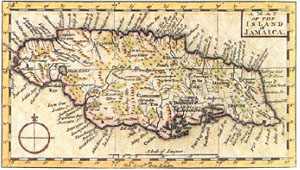
Jamaica's
parishes in 1762
|
| |
|
OVER
THE CENTURIES: 1600- Present Day
|
 |
Coming
November 5: We remember the first 500 Jamaican soldiers sent to World
War I.
|
| Feedback
To the Series |
|
"I have
found your articles on the Pieces of the Past most entertaining
and interesting to read. For me as a historian these pieces come
at a time when Jamaicans need to reconnect themselves with their
past and the Gleaner's efforts through this medium is quite commendable.
I have found
especially today's article on the 1780 hurricane to be quite of
interest to me as I am currently involved in bringing to light the
role of natural disasters in the development of Jamaica's history,
culture, society, economy and politics and the article on the "Hurricane
of 1780" has greatly aided in this direction. Keep up the good
work and I look forward to more interesting and historically significant
pieces from this series." - Kerry-Ann
|
| The
First 500 years in Jamaica |
|
We're
taking you for a stroll down memory lane for the next six
months. Along this journey,we will relive several events which
significantly impacted on the social, political and economic
development of Jamaica. As we travel share your experience
with us...
Send your comments to:
Pieces
of the Past,
The Gleaner Company Ltd.,
7 North Street, Kingston;
E - mail us: editor@gleanerjm.com
Fax 922-6223.
|
|
|