
PiecesPast
[ News | Go - Kingston | Discover Jamaica ]

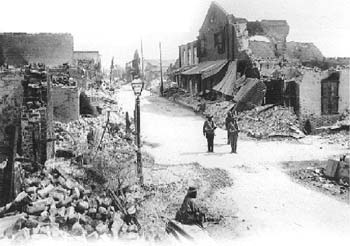
Courtesy of the National Army Museum, London

Disaster - The Earthquake of 1907

MONDAY, JANUARY 14, 1907, 3:30 p.m. It was a regular day ­ sunny and hot ­ with a cloudless sky and what was said to be a faint breeze. At 3:32 p.m. the city of Kingston was busy enough ­ all was alive and well. Suddenly there came the sound of a rushing, mighty wind, followed by the sound of a train roaring in a tunnel and the violent shaking of the earth so that men and buildings were tossed about like puppets. Screams split the air. Within 10-20 seconds a town of 46,000 had been rendered immobile ­ hundreds lay dead or dying buried beneath mounds of rubble and dust. By 3:33 p.m. three shocks had been felt and every building in Kingston sustained some damage; many in the lower part of the city were destroyed.

Accounts of this catastrophe by Sir Frederick Treves and W. Ralph Hall Caine, both published in 1908, report solid brick walls bulging and collapsing, carriages being lifted and flung through the air, telegraph poles swaying like leaves in the wind, and great structures whether made of iron, wood or stone, crumbling. People were simply picked up and tossed while struggling to maintain their balance. More often than not they ended up resembling flailing pawns in an overturned chess game. Those individuals who managed to escape out onto the streets were quickly enveloped in a thick yellow fog punctuated by the sound of crackling and tumbling walls.

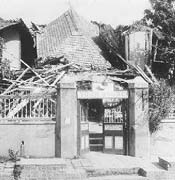
A residence in Kingston - Courtesy of the National Army Museum, London.

What many thought were heaps of dust were actually people trying to move in a city that had suddenly become foreign. Within twenty minutes fire blazed through the streets of Kingston ­ and lasted for up to four days ­ in many cases finishing off what the earthquake had started. It was also not long before rampant looting broke out and armed guards had to be posted throughout the city. At the public hospital, there was no way to cope with the number of wounded. At 3:30 on that fateful day there were some 200 patients in hospital, by 5:00 p.m. that number had risen to 800. According to W. Ralph Hall Caine, who observed much of the devastation from the Port Kingston, the ship on which he had sailed to the West Indies with numerous English businessmen, planters and parliamentarians, 'the sky was a brilliant constellation of glorious lights, the waters over which we passed, dark and awesome, rendered all the more forbidding by the human flotsam and jetsam (from which I must shut my eyes) floating idly on its surface for a ruined city'(p. 230).

Days later Kingston resembled a ghost town ­ empty, silent, dark and broken. £2,000,000 of damage was assessed and over 800 people lost their lives. The Gleaner and the Jamaica Daily Telegraph published death tolls which were scanned by thousands searching for news of loved ones. Only a few received proper burial. Some were buried in large trenches in the May Pen Cemetery and some were burnt without ceremony.

Fortunately within the next few months there was no rain. In Kingston with many people forced to live in the open air, the fear that rain would lead to the outbreak of epidemics like typhoid, dysentery or even the plague was very real.

Assistance came from America, England and Cuba in the form of ships laden with provisions, extra surgeons and soldiers. Not all assistance was met with equal grace, however, as there was some concern, even in the face of such unmitigated disaster, that American troops could land on English soil. The idea of taking aid from the Americans apparently did not sit well with all. An American Admiral landed armed marines without the express sanction of Governor Swettenham who asked for their immediate removal. The Americans were insulted, the Governor forced to apologise and shortly afterward, he tendered his resignation. A relief committee was appointed to collect supplies of food and clothing and distribute temporary housing. Over a quarter of a million pounds of aid was sent from England.

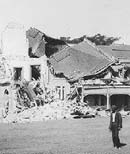
Mico College after the earthquake.
Courtesy of the National Army Museum, London.

Hall Caine saw in this annihilation the chance for Kingston to rebuild, bigger and better than before ­ another Kingston, further removed from the harbour, of broader streets and shaded boulevards. "Kingston is not Jamaica," he wrote. "Theirs is a land of singular beauty, of wood and water, a veritable tropical garden of inexhaustible richness, where anything and everything will grow and prosper. It is a land with a great past and a greater future: if her administrators at home, as well as abroad, will but read their lesson aright, and realize their opportunities today."

In May 1907, Governor Olivier began a tenure that lasted until 1913. Under his watch a new city rose from the ruins. The main public buildings on King Street and the public gardens as well as several new roads were built along a basic grid system. Unfortunately, these town planners clearly neither expected the city to grow as much as it did nor did they factor in the vagaries of vehicular traffic ­ both of which have helped to render the city less than orderly.

In March 1957, fifty years later, another earthquake, the heaviest since 1907, struck the island. This time the western side was the most affected. Luckily, few lives were lost but there was severe property damage ­ the St. James Parish Church was wrecked and in Port Royal a 180m long strip of coast disappeared beneath the sea.
Rebecca Tortello

Major earthquakes in Jamaica:
June 7, 1692 Port Royal destroyed.
August 28, 1712
August 28, 1722
October 20, 1744 Savanna-la-Mar destroyed, Kingston and
Port Royal badly damaged.
November 11, 1812
January 14, 1907 Kingston and Port Royal destroyed.
March 1, 1957: 8 on Richter scale ­ epicenter ­ Hanover.

Source :
C. Black (1983). History of Jamaica. (Kingston: Carlong Publishers Ltd.) The Gleaner (1995). Geography and History of Jamaica (24th Edition). M. Mitchell (1988). Important Dates in the History of Jamaica - Natural Disasters and Events in Jamaica (unpublished - amended November 18, 1996). F. Treves (1908). The Cradle of the Deep (London: Smith, Elder & Co.). W. Ralph Hall Caine (1908). The Cruise of the Port Kingston. (London: Collier & Co.).

Coming January 28 2002:
The series explores the Great Exhibition of 1891.


Give Us Your Feedback | Read what others had to say
Name
E-mail
Country
Comments
Complete List of Past Pieces
• Current
• Port Royal Earthquake
• Port Royal Earthquake : I Was There
• June 20, 1965: Martin Luther King Jr. visits Jamaica
• Bog Walk Tube
• For Your Listening Pleasure
• The Road to Freedom
• Birth of Independence
• Hurricane of 1780
• Tragedy at Kendal 1957
• The Ward Theatre 1912
• The Guarded City: Port Royal 1690
• The Triumph of Will:1960s
• The History of Our Parishes
• Jamaica and the Great War
• Jamaica's Grand Hotels
• Celebrating Christmas Jamaica 'Style'
• Disaster - The Earthquake of 1907
• The Great Exhibition of 1891
• The Mutiny On The Bounty & The Arrival of The First Breadfruit 1793
• The Fall Of A Gentle Giant: The Collapse of Tom Cringle's Cotton Tree
• Jamaica's Botanical Gardens
• All Hail The State Visit Of Emperor Haile Selassie I
• Jamaican Healer And War Heroine Mary Seacole
• Mistresses Of The Sea: Female Pirates Mary Read and Anne Bonny
• The Capital City: A Historic Look At Kingston
• Riots Here: Send Help At Once
• A Historic Portrait of the Town Where Jamaica's Tourism Began
• Devon House -The first 500 years in Jamaica
• Jamaican Coffee - A beverage of distinction
• Jamaican Rum - A kill-devil of a drink
• Jamaica Festival - What a Bam Bam
• Captivated by Jamaica - Sir Hans Sloane's Passion for Jamaica
• Captivated by Jamaica Pt II - Noel Coward, Errol Flynn and Ian Fleming
• The Founding Of The BITU & The JLP
• The Founding Of the People's National Party
• Lewis Hutchinson: The Mad Master
• A Pioneer, A Survivor: Dr. Cicely Williams
•

Henry Morgan: The Pirate King

• Claude McKay: Jamaica's First Poet Laureate
• Frazier versus Foreman on the Sunshine Island 1973
• The Magical Spiderman: Anancy
• The Case Of The Shark Papers
• Katherine Dunham - Matriarch of Modern Dance
• Money - The Roots of Jamaican Currency
• Simon Bolivar: El Liberatador
• Old Time Tellin's: A Closer Look At Jamaican Proverbs
• Recollections of World War II
• Place Names - A Window to Jamaica's History & Character: Wnat's In A Name?
• The History Of Spanish Town
• A Cultural Explication Of Empire: Lady Nugent's Journal
• The History Of Falmouth: Boom Town Of The 19th Century
• Dreamers Among Us - Famous Jamaican Scientists- Prof. Louis Grant 1913 - 1993 Part I
• Dreamers Among Us - Famous Jamaican Scientists-Part II
• Out Of Many Cultures: The People Who Came - The Jews In Jamaica
• Out Of Many Cultures: The People Who Came - The Chinese
• Out Of Many Cultures: The People Who Came - The Lebanese
• Out Of Many Cultures: The People Who Came - The Indians
• Out Of Many Cultures: The People Who Came - The Irish
• Out Of Many Cultures: The People Who Came - The Africans
• Out Of Many Cultures: The People Who Came - The Germans
• Colourful Characters - Jamaican Birds
• The Stamp Of History: The Jamaican Postal Service
• The People Who Came - The English
• Old-time Jamaican weddings
• In this place dwelt Horatio Nelson
• Printing in Jamaica
• Museums in Jamaica
• Gibraltar Camp: A Refuge From War
• HISTORY OF AVIATION IN JAMAICA: PART I
• HISTORY OF AVIATION IN JAMAICA: PART II
• Roads & RESISTANCE
• KINGSTON'S HISTORIC AND DIVERSE PLACES OF WORSHIP RELIGIOUS ICONS part 1
• KINGSTON'S HISTORIC AND DIVERSE PLACES OF WORSHIP RELIGIOUS ICONS part 2
• The history of the Salvation Army in Jamaica CHRISTIAN SOLDIERS
• Somewhere beyond the sea
• A fascination with football
• Jamaican Horse racing History
• A Time to Live...Jamaican Birth Rituals
• A Time to Die Death rituals
• Deadly superstitions


Feedback To the Series

"I have found your articles on the Pieces of the Past most entertaining and interesting to read. For me as a historian these pieces come at a time when Jamaicans need to reconnect themselves with their past and the Gleaner's efforts through this medium is quite commendable.

I have found especially today's article on the 1780 hurricane to be quite of interest to me as I am currently involved in bringing to light the role of natural disasters in the development of Jamaica's history, culture, society, economy and politics and the article on the "Hurricane of 1780" has greatly aided in this direction. Keep up the good work and I look forward to more interesting and historically significant pieces from this series." - Kerry-Ann


The First 500 years in Jamaica

We're taking you for a stroll down memory lane for the next six months. Along this journey,we will relive several events which
significantly impacted on the social, political and economic development of Jamaica. As we travel share your experience with us...

Send your comments to:

Pieces of the Past,
The Gleaner Company Ltd.,
7 North Street, Kingston;

E - mail us:
editor@gleanerjm.com

Fax 922-6223.


A Jamaica Gleaner Feature originally posted January 14, 2002
Copyright 2001. Produced by Go-Jamaica.com