|
The
Triumph of Will - National Heroes
Nanny
and Sam Sharpe two of our seven National Heroes the only two from
the nineteenth century and the last two to be named contributed significantly
to Jamaica's eventual emancipation. The story of any nation's heroes is
one of strength and
sacrifice, bravery and courage, and the triumph of will.
OUR HEROES
were first named in the 1960s when Jamaica celebrated its independence
and celebrated what can be termed a cultural renaissance. Committees were
convened to establish national emblems such as our flag, our anthem, our
symbols, our coat of arms and
our heroes.
The order of
National Hero of Jamaica was created in 1965. The first heroes named were
Sir Alexander Bustamante and Sir Norman Manley, the founders of the JLP
and the PNP respectively, men who served as architects of independent
Jamaica. Named concurrently were Paul Bogle, a preacher and farmer who
led the 1865 Morant Bay Rebellion, George William Gordon, an ex-member
of the House of Assembly, hung for his alleged role in the Morant Bay
Rebellion, and Marcus Garvey, founder of the Universal Negro Improvement
Association (UNIA), a journalist and printer. In 1975 two more heroes
were created: Sam Sharpe, who wound up leading the 1831 Christmas Rebellion
and Nanny, leader of the Windward Maroons.
As recently as October 2000, a new committee for consideration of National
Heroes, the Advisory Committee for the Purpose of the Order of National
Hero, was established. It is chaired by the Rt. Rev. Dr. Neville De Souza,
O.J. and its members include Members of Parliament from both the PNP and
the JLP as well as a folklorist and an attorney-at-law. Yet the committee
has yet to meet although there have been calls from the public for Jamaicans
such as Mary Seacole, Michael Manley and Bob Marley to be considered for
National Hero status.
According to historian Kamau Brathwaite a National Hero should be "a symbol
of transformation, a participant in the struggle for freedom in a particular
moment of crisis, an expression beyond this, of an entire movement of
history; so that although anchored in a specific period, she/he illuminates
the meaning of the whole, establishing correspondences with each step
and stage of the past and linking these through her/his individual achievement
with our sense of nationhood." Nanny and Sam Sharpe fit this description
admirably, she a crucial player in the Maroon Wars of the 1700s, and he
a key figure in the abolition movement of the nineteenth century. They,
like all seven of our heroes, are expressions of our collective memory
and our collective self-esteem.
Article by Rebecca Tortello.
Sources: Gleaner. (1995). Geography and
History of Jamaica. Brathwaite, E. K. (1976) Nanny and Sam Sharpe - Wars
of Respect.
SAM
SHARPE
 |
SHARPE, BORN in the
parish of St. James, and named after his master, is also a folk figure.
He is known for his pivotal role in the 1831 Christmas Rebellion on the
Kensington Estate
a rebellion credited as instrumental to full emancipation in 1838.
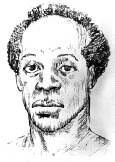
Sharpe (right),
a Baptist preacher, was literate, a strong speaker and very religious.
Sharpe had read many British anti-slavery bulletins and believed that
Jamaica's only chance for redemption was the total abolition of slavery.
Sharpe came up with an idea of passive resistance and communicated this
message to slaves after prayer meetings on different estates. He explained
his belief that the slaves had been freed in England but kept enslaved
by the planters in Jamaica, and described how they could conduct a peaceful
strike a few days after Christmas by simply refusing to return to work
in the fields unless their concerns were heard. Between 18,000-50,000
slaves joined in as news of the idea spread to Trelawny, Westmoreland,
St. Elizabeth and Manchester. Daddy Sharpe's peaceful protest was not
to be however. It quickly turned into the largest slave rebellion in the
island's history.
On December 27, 1831, the Kensington Estate was set afire as a signal
of the rebellion. Soon multiple fires broke out and all thoughts of non-violence
fled. Great houses and cane fields in the west were burned and hundreds
of lives were lost. By the first week in January the rebellion had been
put down by the militia the dead included 14 whites and 500 slaves
most slaves having died during the period of retribution that followed
the rebellion. One such slave was Sam Sharpe who on May 28, 1832 was tried
and hung for his part as organizer.
Sharpe's last words stand as testimony to the type of man he was and the
cause to which he was so deeply committed: "I would rather die in yonder
gallows," he declared, "than live for a minute more in slavery."
This Christmas Rebellion or Sharpe's Rebellion as it is also known, was
pivotal to hastening the process of emancipation. Soon after, the British
House of Commons adopted a motion calling for a Select Committee to be
appointed to put an end to slavery throughout the British Empire. Sam
Sharpe Square in Montego Bay is named after him and his picture appears
on the fifty-dollar ($50) bill.
NANNY
THE MAROON
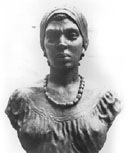 |
NANNY IS a folk figure
(see statute right) an individual who sparked numerous stories and legends.
She nimbly straddles
the realms of reality and myth.
In 1517, when the Spanish ruled Jamaica, the first group of Africans arrived
as slaves. When the British captured the island in 1655, many of the Spanish
left, and their slaves became free. These ex-slaves fled to different
hilly areas around the island. There they banded together to fight against
the British and protect their freedom. They became known as Maroons.
Over three centuries of slavery on the island, some slaves, like Nanny,
escaped from the plantations and joined them. Some believe the name Maroon
comes from the Spanish word, 'cimarron' meaning 'wild.'
Although there is some dispute as to whether Nanny actually existed or
whether she stands as a composite of Maroon female leaders, references
to a leader "Nanny" are recorded in contemporary eye-witness accounts
of 18th century Jamaican history and in secondary material.
For example, the Treaty of 1739/40 mentions granting "Nanny and the people
residing with her 500 acres of land in Portland." In 1735 the slave, Cupid,
reported seeing "three white men that were taken in some of these parties
carried to Nanny Town and there put to death by Nanny." Her name and influence
are cornerstones of Maroon oral tradition.
Although said to be small and wiry she is recognized as a champion of
freedom, a female warrior who promoted guerrilla warfare tactics against
her British foes. She is recognized as a leader who symbolized hope in
times of crisis and fostered respect for her own Ashanti traditions. She
is also immortalized as a high priestess with great powers.
Numerous legends swirl
about her. One credits her with creating a "nanny pot", a cauldron of
water that boiled without fire and trapped unsuspecting British soldiers
enemies of her people the Maroons. Still others speak of deflecting
fire by catching bullets and/or cannon balls in her buttocks. Some say
she is sister to other great Maroon leaders Cudjoe, Accompong, Cuffy,
Quao and Paro.
Nanny is said to have died in the 1750s and is buried at "Bump Grave"
in what is now known as Moore Town in Portland, at the eastern end of
Jamaica. Today Jamaicans honour Nanny as a National Hero out of respect
for her wise, fighting spirit and her commitment to freedom and independence.
An artist's impression of her can be found on the five-hundred-dollar
($500) bill.
- Gordon House is
named after the Rt. Excellent George William Gordon. He was born in
the parish of St. Andrew and his picture appears on the ten-dollar coin.
- Edna Manley's
statue of the Rt. Excellent Paul Bogle stands in front of the Morant
Bay Courthouse in St. Thomas. He was born in the parish of St. Thomas
and his picture appears on the ten-cent coin.
- Marcus Garvey
Drive is named after the Rt. Excellent Marcus Mosiah Garvey. He was
born in the parish of St. Ann and his picture appears on the twenty-dollar
and the twenty-five cent coins.
- Norman Manley International
Airport and the Law School at the U.W.I are named after the Rt. Excellent
Norman Manley. He was born in the parish of Manchester and his picture
appears on the five-dollar coin. He is buried at National Heroes Park.
- Bustamante Highway
and Port Bustamante are named after the Rt. Excellent Sir William Alexander
Bustamante. He was born in the parish of Hanover and his picture appears
on the one-dollar ($1) coin. He is buried at National Heroes Park.
Coming
October 29: The series explores the parishes of Jamaica, then and now.
|
| Feedback
To the Series |
|
"I have
found your articles on the Pieces of the Past most entertaining
and interesting to read. For me as a historian these pieces come
at a time when Jamaicans need to reconnect themselves with their
past and the Gleaner's efforts through this medium is quite commendable.
I have found
especially today's article on the 1780 hurricane to be quite of
interest to me as I am currently involved in bringing to light the
role of natural disasters in the development of Jamaica's history,
culture, society, economy and politics and the article on the "Hurricane
of 1780" has greatly aided in this direction. Keep up the good
work and I look forward to more interesting and historically significant
pieces from this series." - Kerry-Ann
|
| The
First 500 years in Jamaica |
|
We're
taking you for a stroll down memory lane for the next six
months. Along this journey,we will relive several events which
significantly impacted on the social, political and economic
development of Jamaica. As we travel share your experience
with us...
Send your comments to:
Pieces
of the Past,
The Gleaner Company Ltd.,
7 North Street, Kingston;
E - mail us: editor@gleanerjm.com
Fax 922-6223.
|
|
|