Kenneth N. Bingham and Martin H. Bingham, Contributors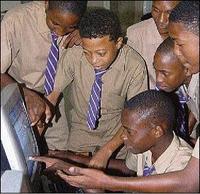
Kingston College students are engaged in an information technology session on January 23 this year. - File
An examination of the facts would seem to suggest a certain correlation between literacy and economic development.
We are a far way off from the optimism and promise that marked the nation's birth. Perhaps most troubling, our economic performance has fallen behind our Caribbean neighbours. According to the study, 'Jamaica: Globalisation, Liberalisation and Sustainable Human Development', conducted by The United Nations Conference on Trade and Development (UNCTAD), "Real growth rates averaging 0.1 per cent of Gross Domestic Product (GDP) throughout the 1990s compare poorly with rates among many of Jamaica's Caribbean neighbours, other middle-income countries and the global average."
By way of contrast, according to the International Monetary Fund's (IMF) executive board, "Barbados was one of the better-performing economies in the Caribbean in the 1990s. During 1993-2000, Barbados grew at three per cent, inflation was less than two per cent, and public sector deficits were maintained at less than three per cent of GDP."
The difference between levels of economic growth must be seen as a result of a complex set of factors. No one should understate the impact of the human resource that has been educated, trained and developed appropriately.
inadequate literacy
We are among countries with the highest levels of expenditure on education when expressed as a percentage of our GDP. Yet we do not see results that reflect this outlay. Perhaps these resources are not being properly utilised or maybe, because we have lagged behind these countries in the past, we now require a greater outlay just to catch up.
What is clear is that we are failing successive generations, many of whom enter adulthood with woefully inadequate literacy levels and have to play 'catch up' themselves, very late in their lives - some never do. This is a major factor in our high unemployment rates, especially among young men, and further, in our high levels of crime and violence which are the inevitable consequences.
reducing illiteracy
If we were as passionate about reducing illiteracy as we are about reducing crime, we would soon have little of either. We can never tame the monster, crime, while its twin brother, illiteracy, remains on the loose. It is unacceptable that almost 46 years after receiving our independence we have yet to fashion a credible policy of compulsory education. Is it any wonder then that our economy has trailed those of other English-speaking Caribbean countries which enjoy much higher literacy levels?
Sixty-three years ago, this month, Clifford Campbell - then Member of the House of Representatives (MHR), introduced a motion to extend gradually, the system of compulsory attendance beyond Kingston and a number of rural townships where it then existed. He spoke of children "running wild and growing up in ignorance" and who were not benefiting from "the training, the care and the education facilities that are provided for them …"
education sidetracked
Sixty-three years on, compulsory attendance does not exist anywhere in the country. We had, then, one of the finest systems of elementary education. In 63 years, we could have judiciously built on it to create an enviable system of universal elementary education - and an educational system capable of driving high levels of development. But we were, in characteristic fashion, sidetracked; and education even became what was sometimes referred to as "political football". How else could the same buildings, often with the same staff and facilities (with barely discernible changes) move from being junior secondary, to secondary, to high schools?
If we were to start over, today, with a genuine desire to help our people, broaden our democracy and secure our liberty, future generations will certainly bless us for the vision and magnanimity we displayed. The suspicion is that they will instead have every reason to curse us for our selfishness and lack of caring and commitment.
The UNCTAD study, cited earlier, had this to say with respect to education: "As the global educational standard keeps rising, Jamaica will need to develop a national passion for education, to be competitive."
The passion is one thing. Education needs to be affordable. Five or six decades ago, children from the poorest circumstances could gain access to education through neighbourhood schools a couple miles away. Today, this is often not the case. A few years ago we came across two students in St Elizabeth who were travelling more than 15 miles daily to an all-age school! Given that these children are often from families with limited resources, it is no wonder that many fail to complete their studies. We need to refocus urgently on the more basic issues - such as access - otherwise our plans might never achieve the desired results.
Greater attention to these and other 'fundamentals' is imperative if we are to achieve the economic progress we all desire. There is one proven way to build and that is, from the bottom up. A solid foundation is the first order of business. We should therefore avoid the tendency to neglect the fundamentals - chase quick fixes and fanciful schemes.
Kenneth N. Bingham is a consultant in human resource management. Martin H. Bingham is an economist. The father/son team may be reached at articles.newera@yahoo.com. Comments may also be sent to columns@gleanerjm.com.