The Caribbean and Europe: Talking about poverty
published:
Sunday | May 25, 2008
Robert Buddan POLITICS OF OUR TIME
Bruce Golding was one of four CARICOM prime ministers to attend a summit with Latin American countries and the European Union in Peru between May 16 and 17.
The meeting was important enough for the prime ministers of Trinidad and Tobago, the Bahamas and Antigua and Barbuda, along with other top government officials from Suriname, Barbados, Belize, St Vincent and the Grenadines, and Guyana's ambassador to Brazil, to attend.
Themes
These very important people had some very important things to talk about. The themes of their meetings were: Addressing our People's Priorities Together: Poverty, Inequality and Inclusion; Sustainable Development: Environment, Climate Change and Energy; and Priorities for a Sustainable Caribbean-EU Partnership. Those priorities include integration, implementation, cooperation and balancing energy needs with food security against the challenges of climate change.
We hope these very important people addressing these very important issues will bring about very important changes. The Cubans addressed this directly. If people's priorities are poverty, inequality and inclusion then Europe can and should do a number of very reasonable things working with Latin America and the Caribbean (LAC).
cancel foreign debt
José Ramon Machado Ventura, the vice-president of Cuba, said that the EU should cancel the foreign debt of the LAC countries. Those debts have been repaid many times over and the repayment is being used for wasteful and destructive actions like war, opulence and carbon emissions.
The EU should also reduce its heavy subsidies of agriculture. Subsidies allow European farmers to earn more than they would in a competitive environment. 'Free' access to European markets will not mean a thing if those markets are subsidised and Caribbean producers are not able to compete on a level playing field with European producers.
The vice-president also said that European partnership agreements (like the one recently initialled by the Caribbean) should serve people's priorities of overcoming poverty, inequality and exclusion. If Europe were to devote just 10 per cent of its annual military budget to this, $30 billion could be spent on health and education in the region. Furthermore, if the EU would honour its international commitment to devote a mere 0.7 per cent of its GDP to official development assistance (ODA), it would be able to provide 40 billion of additional euros in aid, a part of which would be to the benefit of the LAC.
As for climate change, the EU needs to abide by international agreements to limit carbon emissions to 40 per cent of their 1990 levels. Furthermore, it should transfer clean technologies to the LAC so that they will not repeat the error of the ways of the first industrialised countries. Those countries have contributed 76 per cent of all the greenhouse gases emitted into the atmosphere since 1850. If Latin America and Africa were to join Asia to repeat the environmentally destructive model practised by Europe and North America, the planet would only die more quickly.
Irony, Tragedy and Alternative
There is irony and tragedy in all this. The Cuban vice-president remarked that while countries like the EU were threatening Cuban sovereignty by demanding that Cuba 'liberalise', it was the same model of liberalism on a world scale that was contributing to the poverty, inequality, exclusion, and global warming that Cuba had largely solved. The tragedy is that many of these plans and priorities are not new - debt cancellation, increase of ODA, removal of unfair trading practices, technology transfer - have all been talked about since the 1960s and 1970s and some of them have been written into international agreements that European countries have signed.
crises
The crises of energy, food, weather, and poverty seem intractable only because our priorities are wrong. Cuba, not a rich industrial country, shows that if your priorities are to end poverty, inequality and exclusion, the problems can be dealt with though honesty of will.
Cuba pointed out to the summit that Europe could do much better. Cuba itself has placed 34,000 health specialists in 27 countries of LAC. It has provided free surgical operations to more than one million blind or visually impaired persons in 30 countries of the region in just the last four years. It has graduated 15,000 students from 32 LAC countries from its universities and learning centres. It will soon graduate another 26,000 most of who (23,000) are studying medicine in Cuba. Cuba has helped three million former illiterates to read and write all over the LAC in the last five years.
'wasting' money
Think of how much the EU could do if it were not spending so much on its military, wasting food from overproduction, and subsidising farmers to produce food that is sometimes thrown away because of overproduction, enough to feed hundreds of millions of people. Think of how much the United States could do if it were to devote even 10 per cent of its almost US$600 billion annual military budget to fight poverty, inequality, and exclusion in its own backyard, the LAC countries.
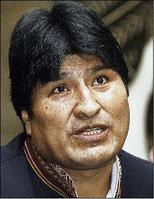
Bolivia's President Evo Morales.
A country like Bolivia is an example of the perverse priorities of the world order. It was one of Latin America's poorest countries, especially its indigenous people. Bolivia had large reserves of oil and gas, controlled by western multinationals, the wealth from which went to the few, as is often the case. Bolivians elected Evo Morales, an indigenous Bolivian, as president in 2005. Evo Morales proceeded to use the oil and gas profits to attack poverty, inequality, and exclusion. Cuba has been helping Bolivia to eradicate hundreds of years of illiteracy through its 'Yes, I Can' programme. Bolivia is on track to eliminate illiteracy, for the first time after over 470 years since the Spanish conquest, by the end of 2008, just three years since Morales' election.
One indigenous leader sums up what this means. He said, "Before learning to read and write it was as if we were blind, but now we are no longer lost. We are more independent." Cuba's eye care programme allows people to see, and its literacy programme allows those who see to read and write. This is where freedom begins. Many Jamaicans cannot read and write and cannot know about the world and alternative ways of developing outside of the daily diet of news from the United States. There are alternatives.
alternative models
Some CARICOM countries are trying to get the benefit of alternative models of development. Dominica, Antigua and Barbuda, and St Vincent and the Grenadines, have signed a Memorandum of Understanding with the countries of the Bolivarian Alternative of the Americas (ALBA) - Cuba, Venezuela, Bolivia and Nicaragua. They have not done so out of ideology or any antagonism to the west but simply for the benefit of their citizens. ALBA is more flexible than the European Partnership Agreement and NAFTA.
Countries like Jamaica can enjoy its benefits without joining and we have been ding so. We have enjoyed the benefits of PetroCaribe, the Cuban eye care programme (Operation Miracle), the Cuban Light Bulb Programme, and other forms of assistance in agriculture, housing, and infrastructure.
It is these forms of assistance that Golding and CARICOM must insist upon from the European Union if we are to talk honestly about partnership and working together to address poverty, inequality, and exclusion.
Robert Buddan lectures in the Department of Government, UWI, Mona. Email: Robert.Buddan@uwimona.edu.jm or columns@gleanerjm.com.