Paul Messam, Gleaner writer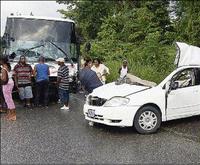
Onlookers view a Toyota Corolla motor car and a Hino bus that were involved in a motor vehicle collision along the Orange Bay main road in Hanover.- Photo by Dalton Laing
Poor driver concentration is listed as one of the main contributing factors to the number of deadly crashes on our roads. Staying alert while driving is one of the essential elements of safe driving, and according to Paul Clemetson, senior director of the Road Safety Unit in the Ministry of Transport and Works, this is key in avoiding and preventing serious accidents.
"How you drive may make the difference between life and death. Concentration involves being patient, staying calm and reading the road ahead," he says.
In fact, the Oxford dictionary describes concentration as "mental attention". Since the brain controls driving, safe driving is mainly a mental decision-making task.
When a driver is in full control, he will be able to manoeuvre the vehicle he is in command of safely and efficiently.
it pays to be defensive
Apart from giving the road and others users your full attention while driving, it also pays to be defensive. A defensive driver should not only know the road code, but should take time out to study the norms, new driving trends and road conditions of the geographic area within which he is travelling.
Alex Miller, a driving examiner for Strathclyde Police in Scotland, once said that every car is a lethal weapon which provides the potential for killing. Motor vehicle manufacturers recognising this, have invested large sums and have gone to great length to improve the safety features built into modern cars.
Psychologist, Zulnara Port Brazil, is of the view that the car amplifies a human faculty, that of movement, making it possible to cover distances more rapidly than he would be able to by his own means.
"Fatigue comes quickly when the muscles of the driver are taut, so every effort must be made to remain physically relaxed and concentrate on your driving; while keeping mentally alert," advises Dr H Persaud, general practitioner.
remain focused
According to him, a driver should keep his head up, and remain focused and aware throughout the journey, especially as he negotiates the curves and turns of the road.
Apart from the obvious benefit of increased visibility, keeping the head up lessens fatigue. When a driver's head is drooped forward or tilted back, the neck and shoulder muscles are operating at a decided mechanical advantage.
Additionally, your eyeball muscles are at full stretch when his head is either way forward or back. "This can be weary to the eyes and certainly affect the driver's concentration," Persaud adds.
booklets
In a series of booklets designed to help both learners and qualified drivers, Britain's Royal Society for the Prevention of Accidents reminds drivers that a car can only be as safe as the driver at the wheel and recommended that all drivers "read the road".
Read the road 1:
Search for early indications of road and traffic situations. The defensive driver should look ahead searching for information that will alert him or her to possible hazards. By so doing he will be aware of what is happening at the side of the road.
Read the road 2:
Observe the location, weather, time and other road-users. Where the driver is should influence his driving (in town or in the rural areas). Wet roads and very strong winds are hazardous. Glare, either from the sun or from an oncoming car's headlight, might blind a driver temporarily or at least drastically reduce his vision. Vacation time or public holidays bring many inexperienced drivers on to the roads. Drivers should watch out for pedestrians crossing the road in front of the bus they overtake.
Read the road 3:
Predict how what you observe will affect your driving. Decide carefully how to cope with this and drive through the situations safely.
Eugene Green, instructor, reminds motorists to:
1. Ensure that their vehicles are in good working order.
2. Be aware of the blind spot in your vision.
3. Check mirrors regularly for what is happening behind and alongside your vehicle.
4. Look carefully ahead to the far distance, middle distance as well as close by.
5. Make it a priority to give the passengers a comfortable and smooth ride.